


Beginning Lent 2026, I am hosting a public reading group to work through John Milton’s Paradise Lost together in weekly installments.
Unlike some other online reading groups devoted to Milton’s epic poem, this group takes the poem seriously as a work Christian devotional literature.
The assumption in these discussions will be that Milton’s poem can be read and enjoyed as a work of literature in a “mere Protestant” frame, and is spiritually edifying for credal, practicing Christians.
Here, we adopt a perspective broadly harmonious with that proposed by C. S. Lewis in A Preface to Paradise Lost (1942). Though by no means does Lewis’s reading have the final word on the poem.
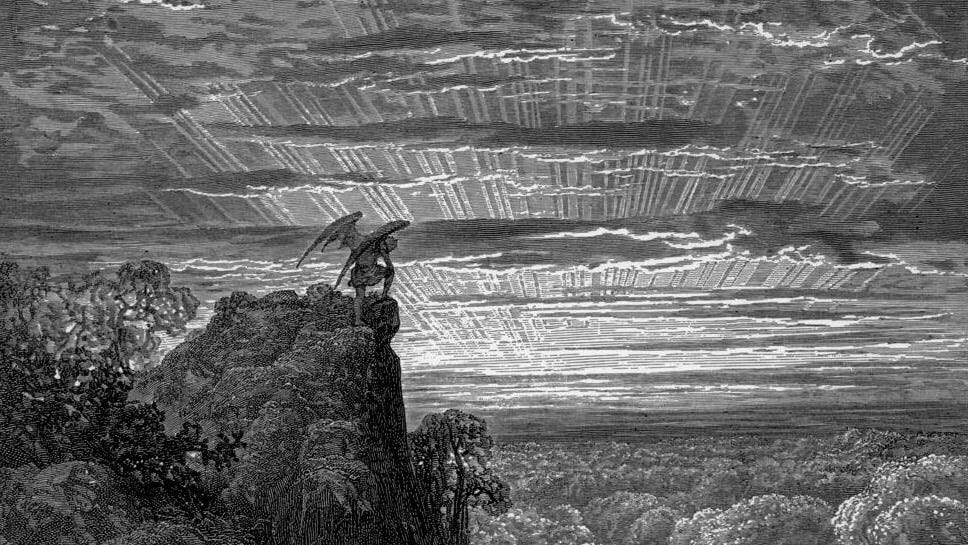
There is additionally a private, live reading group of Paradise Lost which will meet tentatively on Zoom, Sunday evenings at 8pm Eastern, beginning February 22. The live group will read the passage out loud, and discuss whatever questions or comments come from that reading. The private group for 2026 is capped at 12 participants, and is currently full. If you’re interested in joining the waiting list, fill out this form.
Here on the public Substack, I’ll post discussion questions and occasional notes from the live group for anyone wanting to read along on their own at their own schedule.
Provisional Schedule
Below is the provisional reading schedule. This schedule may change based on interruptions in the live group, which I will update here.
February
Feb 22: 1.1–330
Opening invocation; Satan and Beelzebub rise from the fiery lake; Satan summons his army of fallen angels
March
Mar 1: 1.331–798
Introduction of the chief demons; the demons arrange themselves battlements; Mammon leads the building of Pandemonium
Mar 8: 2.1–505
The council of hell: Molech, Belial, Mammon, and Beelzebub present strategies; Satan undertakes the attempt
Mar 15: 2.506–1055
The demons settle into hell; Satan ventures to the gates of Hell; encounters the guardians there; directed by Chaos to the new world
Mar 22: 3.1–343
Poetic ascent to the heavenly throne; God observes Satan’s escape; Father and Son decree what will take place and make a covenant of redemption
Mar 29: 3.344–742
Heaven erupts in praise to the Triune God; Satan finds the newly created world; Satan disguises himself and lands near Paradise
April
Apr 5:Easter SundayApr 12: 4.1–491
Satan arrives in Eden, laments his state; sees Adam and Eve and briefly halts, then resolves his plan; Adam and Eve discuss their creation
Apr 19: 4.492–1015
Satan’s envy of the human couple; Uriel and Gabriel discuss an intruder and discover Satan’s disturbing Eve’s dream; angels question Satan
Apr 26: 5.1–450
Eve describes her troubled dreams to Adam; the pure work and worship of Paradise described; Raphael sent to warn Adam and Eve
May
May 3: 5.451–907
Adam asks Raphael to describe angelic life; Raphael instructs Adam in the nature of sin, the great rebellion, and tells of Abdiel’s resistance
May 10: 6.1–445
Raphael tells Adam about the war in heaven: the fight of Michael and Gabriel against the rebels; the first day of fighting and retreat
May 17: 6.446–912
Satan rallies his hosts for second day of war; the siege of artillery and mechanical warfare; the Father sends the Son to end the rebellion
May 24: 7.1–60
Raphael describes to Adam the creation of the world; the Son’s work in creation; the adoration of Heaven
May 31: 8.1–653
Adam continues to inquire of Raphael; Adam describes his own history; Raphael admonishes Adam and departs
June
June 7: 9.1–375
Satan returns to Paradise as a serpent; Eve suggests they separate to divide the work; Adam resists, and yields, reminding Eve of their warning
June 14: 9.376–779
The serpent finds Eve alone and tempts her to eat the forbidden fruit; Eve considers the fruit, and reasons of its Divine goodness
June 21: 9.780–1189
Eve eats the fruit; Adam joins her fate; they fall into lust and hatred toward one another; they attempt to cover their naked shame
June 28: 10.1–503
The Father sends the Son to judge Adam and Eve, who clothes them; bridge between Hell and the World paved; Satan returns to Hell to boast
July
July 5: 10.504–1104
Heaven judges the fallen angels; Adam falls into depression, and is consoled by Eve; they pray in repentance and supplication
July 12: 11.1–422
The Father and Son send Michael to instruct and eject Adam and Eve; Adam and Eve lament; Michael brings Adam to a mountain
July 19: 11.466–901
From the Mount, Michael shows Adam a prophetic vision of the future plan of redemption through his offspring; until the Flood
July 26: 12.1–649
Michael continues relating God’s redemption from the Flood until the First and Second coming; Michael leads Adam and Eve out of Paradise.
Recommended Resources
You can read along with any copy of the 12-book version of Paradise Lost (don’t worry, the original 10-book version is exceedingly rare). Just make sure your copy has numbers every 5 or 10 lines.
Print editions
I’ll be using the Oxford World Classics edition (ed. Orgel & Goldberg) as my primary text.
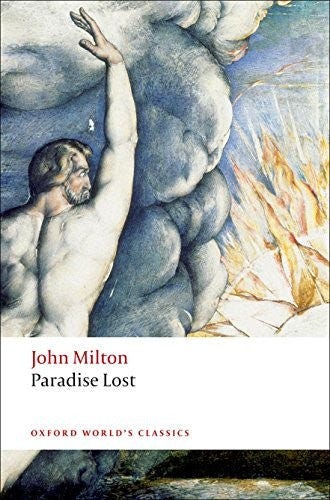
Bookshop.org | Barnes & Noble | The Dark Lord
I think this Oxford edition has the best balance of notes-to-poem per page for this kind of reading. There are enough to help you along, but not overwhelming.
If you’ll want to do a deep study of the text, the gold standard is Alistair Fowler’s Longman edition. But beware: it’s not uncommon to have 70% of the page as notes and commentary. It’s also a bit pricey ($73), but there are plenty of used copies of older editions online.
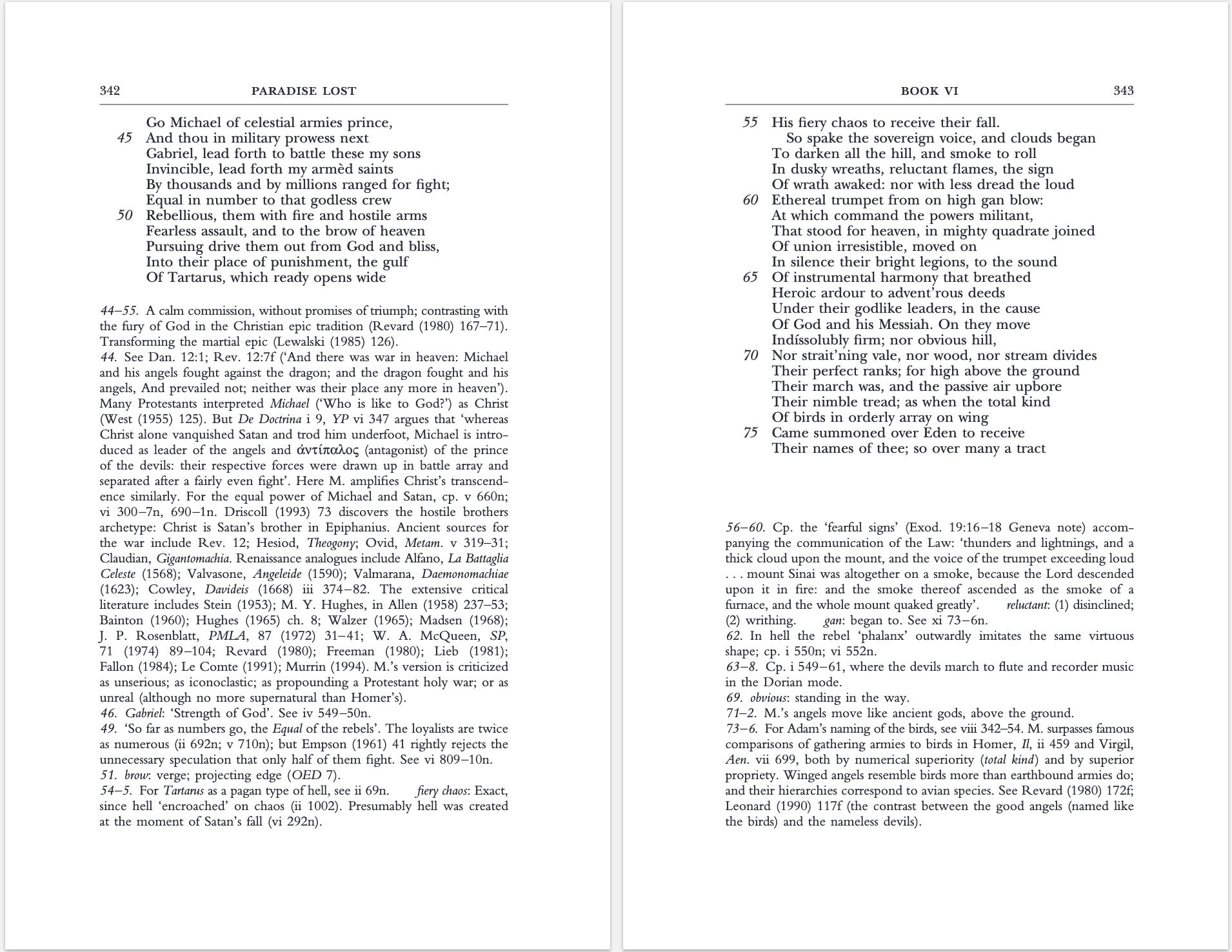
Another great study text is Barbara K. Lewalski edition for Blackwell, which seems to be out of print in the US. But there seem to be plenty of secondhand copies floating around online retailers. The best readily-available study text is the Norton Critical edition by Gordon Teskey.
Online editions
I recommend this online version of the text:
The Milton Reading Room at Dartmouth
Audio recordings
There are excellent audiobook recordings, which make listening a delight.
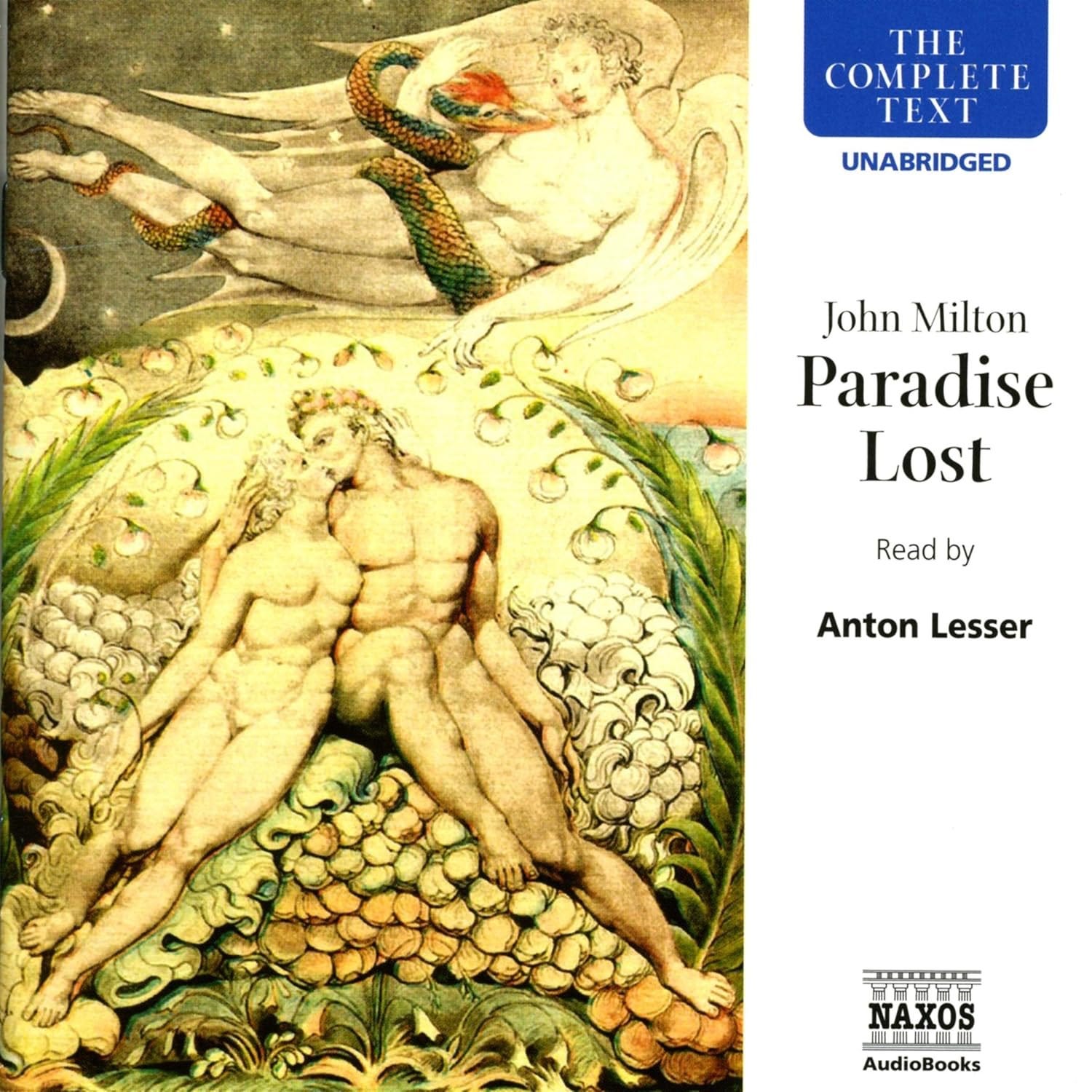
The best audiobook is Anton Lesser’s recording with Naxos. His reading of the text is the most accurate and lucid. As an accomplished Shakespearean actor, he is very clearheaded in his reading of early modern English poetry.
I also enjoy Simon Vance’s recording for Tantor. His baritone voice is more pleasant for extended listening than Lesser’s tenor, and his performance and rendering of the text is solid.
If you want to prioritize clarity and understanding the poem, choose Lesser. If you want to enjoy the poem like music, go with Vance. The other available recordings are far inferior.
Join the journey!
Of course, the only thing better than listening to a great narrator is to read it out loud yourself. So whether you choose to join the live reading group or read along on your own, Paradise Lost rewards time spent reading and discussing it with others. Please share your thoughts and questions as we go.